Home Extension or Moving House? Nicky’s Top Tips for Deciding Whether to Move or Improve
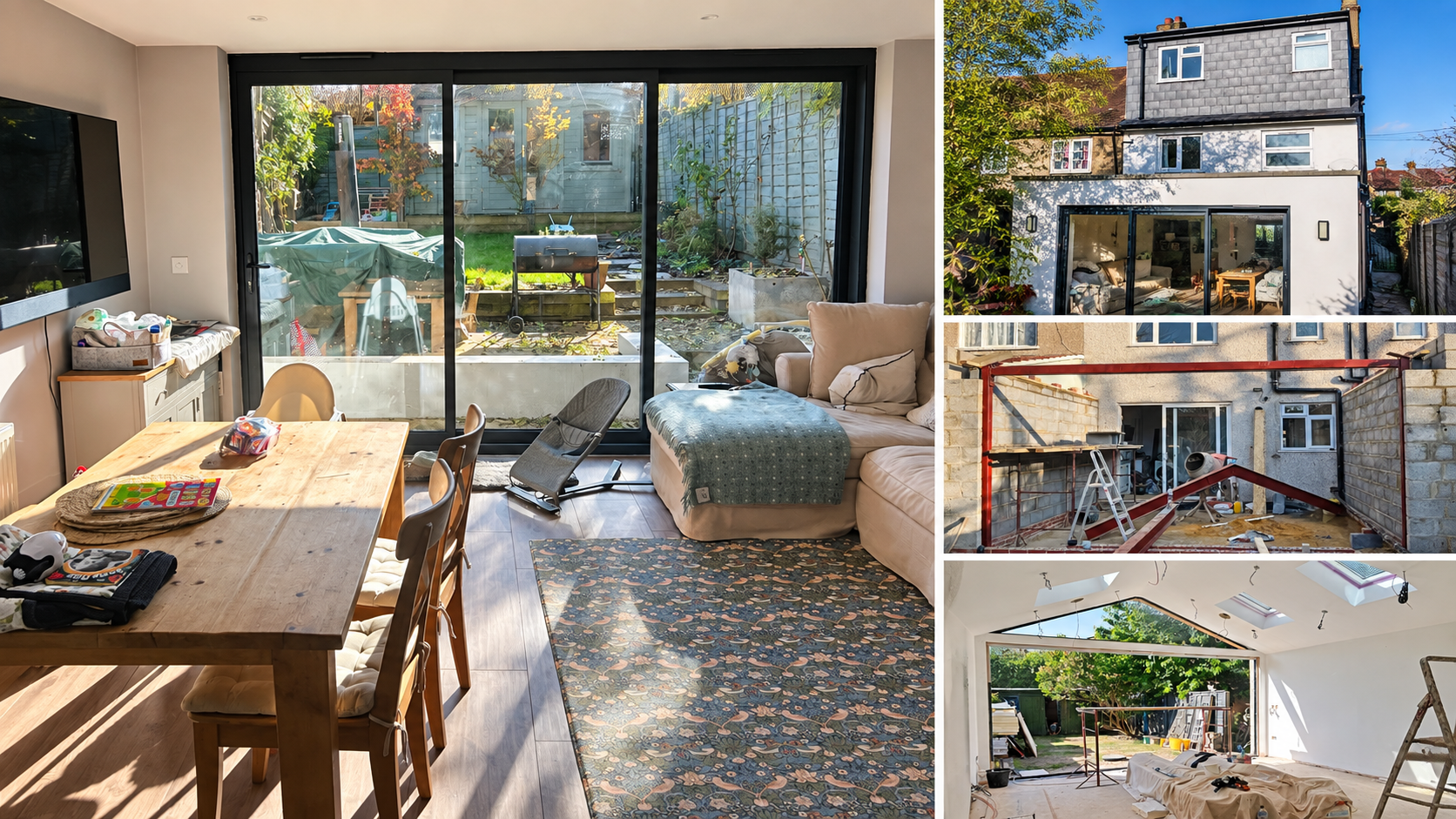
A Livspace home extension project in SW16, showing the transformation from the structural build stage through to a bright, finished living and dining space with large glazed doors opening onto the garden.
You love your home. You like the area. The neighbours are good, the commute works, and the children are settled.
There’s just one problem: you’re running out of space.
It’s a situation we hear about a lot. You might need another bedroom, a bigger kitchen, a space to work from home, or simply more room for everyday family life.
So, do you extend the home you already have or start looking for somewhere bigger? There isn’t one answer that works for every homeowner, but if you’re weighing up your options, here are some benefits of extending rather than moving.
1.You get to stay in a home and area you already love
Moving house isn’t just about finding a bigger property.
You may also be giving up things that are much harder to replace: good neighbours, local schools, your commute, favourite parks, nearby family and friends, or simply being part of a neighbourhood you know.
If the main thing that isn’t working about your current home is the amount or type of space you have, an extension can potentially solve that problem without changing everything else.
Nicky’s tip: Start by asking yourself what you’d actually want to change about your home. If the answer is mainly “we just need more space”, it’s worth exploring what could be achieved before putting up the For Sale sign.
2.The money you spend goes into your existing home
Buying another property comes with costs that don’t create any extra space.
In England, moving to a more expensive home can mean paying Stamp Duty, alongside estate agent fees, legal fees, surveys, removals and potentially mortgage-related costs.
Current Stamp Duty for someone replacing their main home starts at 0% on the first £125,000, then rises through several bands, including 5% on the portion between £250,001 and £925,000.
With an extension, your budget is instead being used to change the property you already own.
That doesn’t automatically mean extending will always be cheaper than moving; the cost depends enormously on the property, the type and size of extension, structural work and specification.
But it does mean you can compare the cost of creating the space you need with the full cost of moving, rather than simply comparing your build quote with the asking price of another house.
3.You can create space around the way you actually live
One of the biggest advantages of extending is that you’re not buying someone else’s idea of the perfect home.
You can start with the problem you want to solve.
Perhaps you need:
a larger kitchen and dining area,
more family living space,
a utility room,
somewhere to work from home,
better access to the garden,
another bedroom or bathroom,
a more practical ground-floor layout.
The extension can then be designed around those needs.
Nicky’s tip: Don’t begin with “we want a three-metre extension”. Begin with “this is what isn’t working in our home”. The layout should follow what you need the space to do.
4.An extension can improve the existing house too
Creating additional square footage is only part of a successful extension.
Sometimes the biggest improvement comes from what happens to the existing space.
An extension might let you open up a cramped kitchen, improve the flow between rooms, bring in more natural light, or create a much better connection between the house and garden.
It’s why we encourage homeowners to think about the whole ground floor rather than viewing the extension as a separate box being added to the back of the house.
The question isn’t only:
“How much more space can we get?”
It’s:
“How can we make the whole house work better?”
5.You may have more options than you realise
Not every extension requires a full planning application.
Depending on the property and the proposed work, you can carry out some home extensions under permitted development rights, subject to specific limits and conditions. For example, permitted development rules limit how much of the land around the original house can be covered by extensions and other buildings.
Planning permission and Building Regulations are also different, so it’s important to establish what applies to your project before you make plans.
If you live in a conservation area, have an Article 4 Direction affecting the property, or your home has already been substantially altered, different restrictions may apply.
6.You avoid the compromises that often come with moving
Finding a bigger home doesn’t necessarily mean finding your ideal home.
You may get the fourth bedroom but lose the garden.
You may find the perfect kitchen but add 30 minutes to the school run.
Or you may pay considerably more for the additional space and still end up wanting to change the property once you move in.
Extending gives you the chance to decide what you want to keep and what you want to improve.
7.A well-planned extension may add value to your home
Adding useful living space can make a property more attractive to future buyers, particularly when the extension creates something homeowners genuinely value, such as a larger kitchen, an additional bedroom or improved family space.
But we’d always be cautious about treating an extension purely as an investment calculation.
The value isn’t only what you might eventually get back when you sell.
If an extension lets your family stay happily in the home for another five, ten, or fifteen years, there’s value in that too. And it’s important not to assume every pound spent on a build will automatically be reflected pound-for-pound in the eventual sale price.
When might moving be the better option?
Sometimes an extension simply won’t solve the underlying problem.
Moving may make more sense if:
you want to live in a completely different area.
you need a much larger garden or plot.
the property cannot realistically accommodate the space you need.
planning or structural constraints make the proposed project impractical.
the changes required would be disproportionate to the house.
you simply don’t want to live through building work.
An extension should improve your home, not force a solution that doesn’t make sense.
Nicky’s top tip: compare the two options properly
If you’re stuck between moving and improving, don’t just compare the price of another house with the headline cost of an extension.
Write down:
If we move
What would the next property realistically cost?
What would we pay in Stamp Duty?
What other selling, legal and moving costs would we incur?
Would the new property still need work?
What would we be giving up about our current location?
If we extend
What space do we actually need?
What type of extension could create it?
What would a realistic budget be?
What permissions might be required?
How could the project improve the rest of the house as well?
Then you’re comparing two complete options, rather than two headline prices.
Thinking about extending your home?
If you like where you live but your home no longer gives you the space you need, it’s worth finding out what might be possible before deciding that moving is your only option.
At Livspace, we work with homeowners across South London to create loft conversions, home extensions and full home renovations designed around how they actually want to live.
Thinking about creating more space at home? Talk to Nicky and the Livspace team about your ideas.